Welcome to Neuroscience Nuggets, your treasure trove of brain science knowledge designed to unlock the secrets of personal and professional growth! If you've ever been curious about the power of the brain and how it influences our thoughts, emotions, and behaviors, you're in the right place!!
Neuroscience, the captivating study of the brain and nervous system, offers a goldmine of insights to enrich our lives and those of our clients. At Neuroscience Nuggets, we're dedicated to making brain science approachable, exciting, and applicable in all aspects of your journey. Whether you're seeking to nurture your own well-being or enhance your professional practices, our nuggets of wisdom will equip you with practical tips, strategies, and evidence-based approaches to empower yourself and your clients.
Join us as we embark on an exhilarating adventure into the realm of neuroplasticity—the brain's remarkable ability to change and adapt. Together, we'll explore how harnessing neuroscience can lead to personal fulfillment, enrich your relationships, and supercharge your professional impact. So, grab your pickaxe and get ready to dig deep into the world of neuroscience nuggets. Let's unlock the untapped potential of the brain and unearth the pathways to personal and professional growth together. 🌱🌟
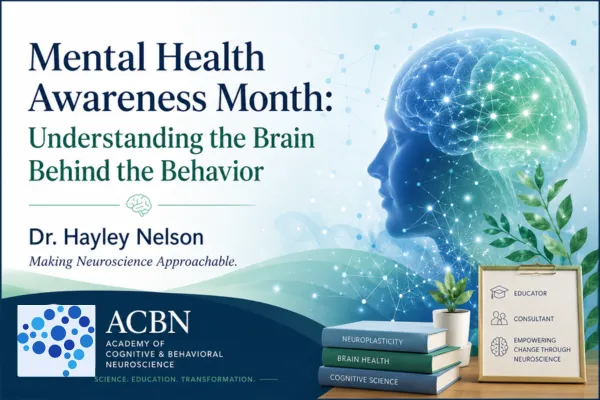
Mental Health Awareness Month: Understanding the Brain Behind the Behavior
Mental Health Awareness Month: Understanding the Brain Behind the Behavior
Every May, Mental Health Awareness Month gives us an important opportunity to have conversations that many people still avoid.
Despite how common anxiety, depression, trauma-related disorders, ADHD, and other psychological challenges are, stigma still keeps far too many people silent. People often feel shame for struggling, as though mental health challenges are somehow a personal weakness instead of what they truly are: complex interactions between brain function, biology, environment, stress, and lived experience.
As someone who teaches cognitive and behavioral neuroscience, one of the most important messages I try to share is this:
Mental health is brain health.
When we understand the neuroscience behind psychological disorders, we move away from blame and toward compassion, support, and better solutions.
Your Brain Is Not “Broken”
One of the biggest misconceptions about mental health is that people should simply be able to “snap out of it.”
But the brain does not work that way.
Psychological disorders often involve measurable changes in brain structure, neurotransmitter activity, nervous system regulation, inflammation, hormonal signaling, and neural communication patterns.
This is not about weakness.
This is biology.
Take anxiety, for example:
The amygdala, often called the brain’s threat detector, helps us identify danger and stay safe. In chronic anxiety, that alarm system can become overactive, making ordinary situations feel threatening.
At the same time, the prefrontal cortex, the area responsible for logic, decision-making, and emotional regulation, may have a harder time calming that alarm.
This means someone with anxiety is not “overreacting.”
Their brain is processing the world through a heightened survival lens.
Depression Is More Than Sadness
Depression is often misunderstood as simply feeling sad, but neuroscience tells us it is far more complex.
Depression can involve disruptions in serotonin, dopamine, and norepinephrine pathways, all of which influence motivation, pleasure, focus, and emotional regulation.
We also see changes in areas like the hippocampus, which plays a role in memory and stress regulation, and the anterior cingulate cortex, which helps process emotions.
This is why depression can feel like exhaustion, brain fog, numbness, irritability, and disconnection—not just sadness.
Telling someone to “just be positive” is like telling someone with a broken ankle to simply walk it off.
It misses the biology entirely.
Trauma Changes the Nervous System
Trauma is not just an emotional memory.
It is often a nervous system experience.
Chronic stress and trauma can alter the hypothalamic-pituitary-adrenal (HPA) axis, affecting cortisol regulation and keeping the body in a prolonged state of fight, flight, freeze, or fawn.
This can show up as hypervigilance, emotional reactivity, sleep disruption, digestive issues, difficulty concentrating, and relationship challenges.
People are often judged for these symptoms without recognizing that their nervous system may still be trying to protect them.
Healing requires more than “getting over it.”
It requires safety, regulation, and support.
Neuroplasticity Gives Us Hope
The good news is that the brain is adaptable.
This is where neuroplasticity becomes incredibly important.
Neuroplasticity is the brain’s ability to reorganize, form new neural pathways, and change across the lifespan.
Therapy, exercise, sleep, mindfulness, nutrition, social connection, stress regulation, and evidence-based interventions all help shape the brain in meaningful ways.
Healing is not instant, but it is possible.
Brains can change.
Patterns can shift.
People can recover.
This adaptability is also why researchers continue exploring the connection between movement, cognition, and mental wellness. Even activities that challenge balance and coordination can stimulate important communication pathways between the brain and body. I was recently featured in an article in Parade discussing unconventional balance exercises that challenge the brain alongside the body - another reminder that mental and physical health are deeply interconnected. You can read a nice summary of the article on AOL here: 6 Unconventional Balance Exercises That Challenge Your Brain, Too
Why Stigma Is So Dangerous
Stigma delays treatment.
It keeps people from asking for help.
It makes people feel isolated.
It turns suffering into secrecy.
And often, the people who need support the most become the least likely to seek it.
When we shame mental health struggles, we create barriers to healing.
When we educate, we create pathways forward.
This is why advanced research, neuroscience education, and open conversations matter so much.
The more we understand the brain, the less room there is for judgment.
What We Need More Of
We need fewer labels used as insults.
We need fewer assumptions.
We need fewer “just try harder” conversations.
We need more education.
More compassion.
More access.
More evidence-based support.
More conversations that remind people they are not alone.
Mental Health Awareness Month should not just be about awareness.
It should be about action.
It should be about building systems, workplaces, schools, and communities that understand the brain and support the human being attached to it.
Because mental health is not separate from health.
It is health.
And when we start treating it that way, everything changes.
Final Thought
If you or someone you care about is struggling, please remember this:
Struggle is not failure.
Support is not weakness.
And understanding the brain changes the conversation.
The more we replace stigma with science, the more healing becomes possible.
That is the work worth doing.
And that is exactly why Mental Health Awareness Month matters.
Turning Awareness Into Understanding
If you’re passionate about understanding the brain and helping others create meaningful change, this is exactly why we created certification programs through the Academy of Cognitive and Behavioral Neuroscience.
Making neuroscience approachable means helping professionals use brain-based strategies that actually improve lives.
If you’re ready to deepen your knowledge, explore our certifications or schedule a discovery call to learn more.
Because when we understand the brain, we change lives.


Meet Your Blogger
Dr. Hayley Nelson earned her PhD in Psychological and Brain Sciences from The Johns Hopkins University, is a tenured professor of Psychology in the Philadelphia area, and is an international speaker. She has over 20 years of teaching experience with students from diverse backgrounds, has several peer-reviewed research publications and previous research and faculty appointments with The National Institutes of Health, The Johns Hopkins University, and The University of Pennsylvania.
If the idea of learning about the brain and neuroscience feels overwhelming and intimidating, Dr. Hayley is the perfect neuroscientist for you. She's a busy mom of 2 with a great sense of humor, and she prioritizes bringing some fun and compassion to a field that can feel a little "hardcore". You can expect lots of real world experiences and examples and an open, caring learning environment where there are no stupid questions. Listening to one of Dr. Hayley's discussions feels more like a conversation with a family member (a really smart family member).
By creating the Academy of Cognitive and Behavioral Neuroscience, Dr. Hayley Nelson combined her knowledge of the human mind and brain health with her passion for education, teaching, and consulting to truly make neuroscience approachable. Her students learn easy-to-swallow knowledge of how the brain works in real-life situations and are armed with an education in a subject they can use literally every single day. Not only that, they gain the power to serve their clients better and create an environment for their communities to thrive.
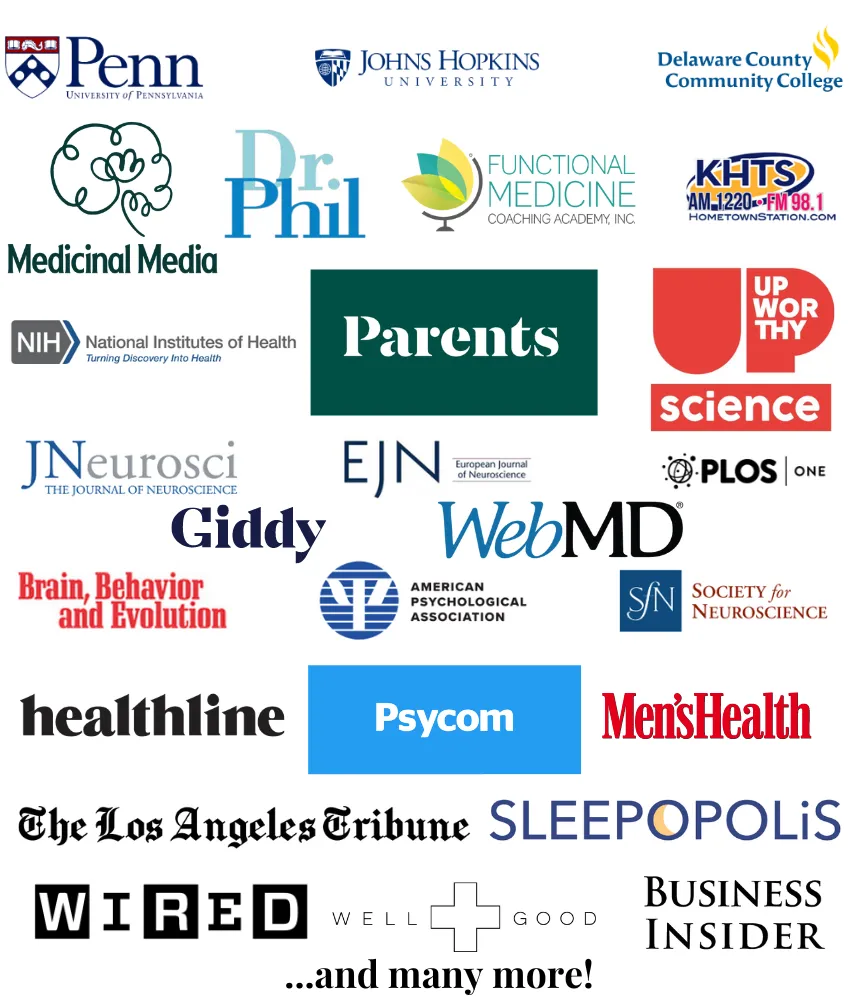
Dr. Hayley's Featured Contributions, Publications, and
Faculty & Research Appointments
With a Certification in Cognitive & Behavioral Neuroscience, you will gain the confidence to speak with authority about HOW & WHY what you teach your clients actually works.
Neuroscience feels intimidating, and perhaps you've always thought that you're not positioned to be an authority on the science behind what's happening in your client's brain. Dr. Hayley Nelson founded the Academy of Cognitive & Behavioral Neuroscience, and she designed this Certificate Program with one goal in mind:
To make neuroscience approachable for professionals who want to distinguish themselves from others in their field with a unique and comprehensive understanding of the latest research and innovative techniques in neuroscience, and earn a highly respected certification in cognitive and behavioral neuroscience that sets them apart as a true expert in their field.
After completion of the certificate, students will uncover a newfound sense of confidence and neuroscience knowledge, will stand out in their industry by offering something unique to their clients, gain credibility, better serve their existing clients, and be positioned to take on more clients best suited for their programs.
Have questions about the Certification Programs from Dr. Hayley and
The Academy of Cognitive and Behavioral Neuroscience (ACBN)?
Want to book a 1-on-1 Office Hour consultation with Dr. Hayley?
Want to See What it's Like to Learn from Dr. Hayley?
Want to Stay in the Loop with Dr. Hayley and ACBN?
Connect directly with Dr. Hayley!
Click the blue chat bubble in the right-hand corner of the screen to get in touch with me, or connect with me on social media.
© 2026 Academy of Cognitive and
Behavioral Neuroscience